
New in Fridg this week: khao soi, bò kho, meatloaf and Ital stew
5 min read
Four more dinners joined Fridg this week, and they travel far: from northern Thailand to Vietnam, across to America and down to Jamaica. Here is the story behind each one.
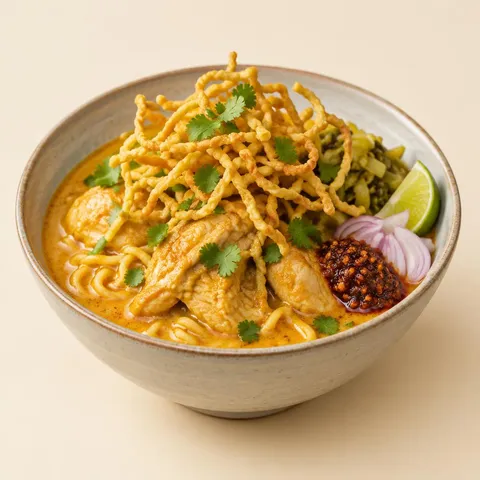 Khao soiChiang Mai's golden curry noodle soup, with crispy noodles on top
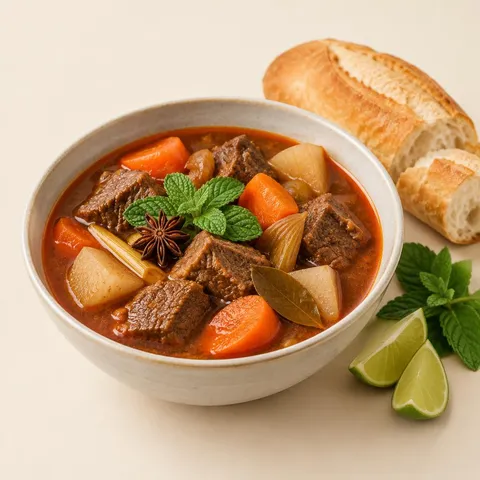 Bò khoA Vietnamese beef stew you mop up with a baguette
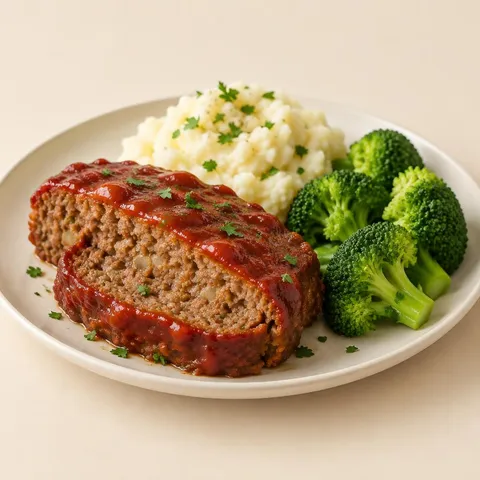 MeatloafThe American classic that fed families through hard times
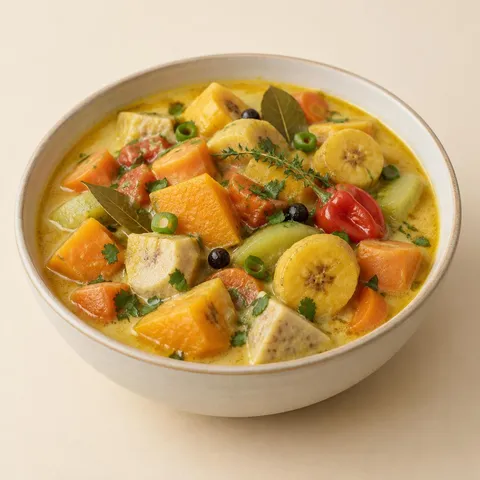 Ital stewA creamy coconut stew from Jamaica's Rastafari kitchen, made without meat
Khao soi
Thai · 1 h · serves 4
Khao soi is a curry noodle soup of northern Thailand, tied above all to Chiang Mai, and one of the signature dishes of the food of Lanna, the old northern kingdom.
The usual story is that it came with the Chin Haw, Chinese Muslims from Yunnan who drove trading caravans through Myanmar, Laos and northern Thailand; the Michelin Guide puts that in the 19th century. Because of those Muslim roots, khao soi is still mostly made with chicken or beef, and rarely with pork.
It comes with crisp fried noodles on top of the soft ones, and lime, pickled mustard greens, shallots and chilli fried in oil to add at the table. Dishes called khao soi are eaten in Laos and Myanmar too, along the old trade routes, but Lao khao soi is a different dish: a clear soup with a tomato-and-meat sauce, not a coconut curry. If your Thai cooking so far has been green and red curries, this is a lovely bowl to try next.
Find it in Fridg: Discover, under Thai. Open it, and one tap puts everything it needs on your shopping list.
Bò kho
Vietnamese · 2 h 30 min · serves 8
Bò kho is a Vietnamese beef stew: beef and carrots in a loose broth scented with lemongrass, star anise, cinnamon and shallots. Before French rule, Vietnamese people ate little beef, because cattle were too valuable as working animals. The French, who ruled from the late 19th century until 1954, brought beef into the diet.
Where bò kho itself began is not agreed on. It is widely thought to be a Vietnamese answer to French beef stews such as pot-au-feu or bourguignon. Its warm spices are often credited to older influences too: Chinese five-spice and star anise, and the Cham civilisation of central Vietnam.
It is eaten with a baguette to tear and dip in the broth (bánh mì bò kho), or ladled over noodles, rather than with plain rice. In Vietnam it is above all a breakfast, though many places sell it all day, and in 2026 TasteAtlas ranked it 36th in its list of the world's 100 best breakfasts. We like it just as much for dinner, with the baguette warm and ready for dipping.
Find it in Fridg: Discover, under Vietnamese. Open it, and one tap puts everything it needs on your shopping list.
Meatloaf
American · 1 h 30 min · serves 8
Mixing minced meat with bread and spices is a very old idea: one writer points to a kind of meatloaf in Apicius, the late-Roman cookbook. Meatloaf has many European relatives, from German Hackbraten, also called falscher Hase, "false hare", to Dutch gehaktbrood and Swedish köttfärslimpa.
The first recorded recipe for American meatloaf comes from New England in the late 1870s: chopped meat bound with milk-soaked bread and egg, eaten at breakfast. The Great Depression made it a staple. A loaf stretched a little cheap ground meat with bread, grains and leftovers to feed a whole family, and recipes were printed on soup cans and ketchup bottles.
Meat rationing in the 1940s kept it on the table, and by the 1950s it was a fixture of the American family dinner: one cookbook of 1958 gave some 70 meatloaf recipes. It still does what it did then: one loaf feeds eight, and the slices left over make the next day's sandwiches.
Find it in Fridg: Discover, under American. Open it, and one tap puts everything it needs on your shopping list.
Ital stew
Caribbean · 1 h 25 min · serves 6 · meat-free
Ital is the way of eating of Rastafari, the religious and political movement born in Jamaica in the 1930s. The word is "vital" with its first letter dropped, and Rastas say Ital is vital.
Ital food is meant to be natural and straight from the earth: no additives or chemicals, little or no meat, and herbs and hot peppers in place of added salt. The sources differ on when the cooking took shape: in the movement's first years in the 1930s, or, as the Jamaica Gleaner has it, in the 1940s.
The Jamaica Tourist Board calls Ital food Jamaica's own take on vegetarian cooking, and Ital-inspired restaurants have since opened abroad, in New York and London among other places. Pumpkin, sweet potato and plantain in coconut make a bowl so full and comforting that nobody asks where the meat went.
Find it in Fridg: Discover, under Caribbean. Open it, and one tap puts everything it needs on your shopping list.